
Finding People Around Middle River
Middle River has no city clerk, municipal court, or city records counter. The useful jurisdiction is Baltimore County, with several statewide Maryland systems layered above it. A name can lead to a court docket, deed, estate, professional license, or business filing. An address can lead to the assessment account and then to the recorded deed. Family history may call for vital records, census schedules, newspapers, or archives.
Choose the route by the fact in hand. A full name works best in court, estate, deed, business, and license indexes. A street address belongs first in the assessment and county mapping systems. An older address may need a directory, census enumeration district, or newspaper archive. Phone searches are weaker because no current official carrier directory or open neighborhood roster was verified for Middle River.
- Normalize the name or address, keeping spelling variants, initials, suffixes, and nearby community labels.
- Use the county or state index that matches the known fact, and save its case, account, estate, or deed reference.
- Open the underlying image or request the file. An index entry is only a discovery aid.
- Compare dates, related parties, and places in a second source before deciding two entries describe one person.
- Ask the custodian, library, or archives when the web search lacks the needed years or document.
Middle River Uses County Records
“Middle River” can describe a census-designated place, postal locality, planning area, or a broader community. None creates a separate municipal custodian. Baltimore County keeps county records, while Maryland agencies maintain court, assessment, voter, licensing, and vital systems. Nearby labels such as Essex, Bowleys Quarters, and White Marsh can appear in the same family trail.
The personal Middle River voter registration lookup can confirm a registrant's own status and election details. It is identity-gated, not an open resident directory, and voter-list data is restricted to electoral purposes under Maryland law.
Keep the street, ZIP code, election district, assessment account, and county with each result. For older work, use the boundary and election district in force at the time. Modern Middle River lines should not be projected onto colonial or nineteenth-century records.
Middle River People Records Custodians
The central local hub is the Clerk of the Circuit Court for Baltimore County in Towson. Its departments handle recorded land instruments, marriage licenses, court files, business licenses, and related services. The Register of Wills keeps estate files. SDAT maintains the assessment roll, while the Maryland State Archives preserves transferred series and historic indexes. Detailed access rules and request steps belong with the Middle River public records system.
Land Records and Licensing
Clerk of the Circuit Court for Baltimore County
Towson, Maryland
SDAT Assessment Office
Baltimore County assessment records
State property system
Real Property Data Search
Trace Middle River Property Records
Start an address search with the SDAT Real Property Data Search. Select Baltimore County, then search by street address, property account identifier, or map and parcel. The public interface is not a general owner-name browser. A result can show the deed owner, mailing and premises addresses, account and map references, legal description, values, transfers, and a liber and folio reference. A liber is a recorded book; a folio is its page.
| Search control | Input | Best use |
|---|---|---|
| Street Address | House number and street name | Find a parcel from a known Middle River location |
| Account Identifier | Baltimore County account format | Reopen an exact assessment account |
| Map / Grid / Parcel | Assessment map references | Match legal and mapped land descriptions |
Mailing and premises addresses answer different questions. The first is where tax notices go. The second is the physical site. Even a principal-residence flag supports, but does not prove, present occupancy. Save both addresses before following the deed.
After recording the assessment details, open Baltimore County My Neighborhood with the same street address. Its map layers connect the parcel to permits, zoning history, house numbers, election districts, precincts, schools, and the Middle River Redevelopment Area. A map click can reveal attributes that a name index will not show. Treat older permit points with care: county research notes that pre-2002 locations may sit on a street centerline, while later locations were placed at parcel centers. The marker is useful context, but it may not be the exact work site. When the map or permit tool lacks the needed record, request the existing nonexempt file from the county department that created it.
Note: Owner, mailing recipient, and current occupant may be three different people, so label each relationship with care.
Follow Middle River Deed Names
The statewide MDLandRec portal uses a free account and serves Baltimore County deeds, mortgages, releases, assignments, easements, and other verified instruments. Use the SDAT liber and folio for direct retrieval, or search the available individual, corporation, fuzzy, and Soundex name paths. Grantor means the party giving an interest; grantee means the party receiving it. Search both roles when tracing a chain.
The portal may show indexed names, role, instrument type, recording date, book and page, and an image link. Read all image pages, including exhibits and legal descriptions. Historic or retired indexes are scanned books that must be browsed, while electronically indexed instruments may open as one PDF. No single start year describes every Baltimore County series.
The official land-record entry screen shows the free-account route used for Middle River deeds.
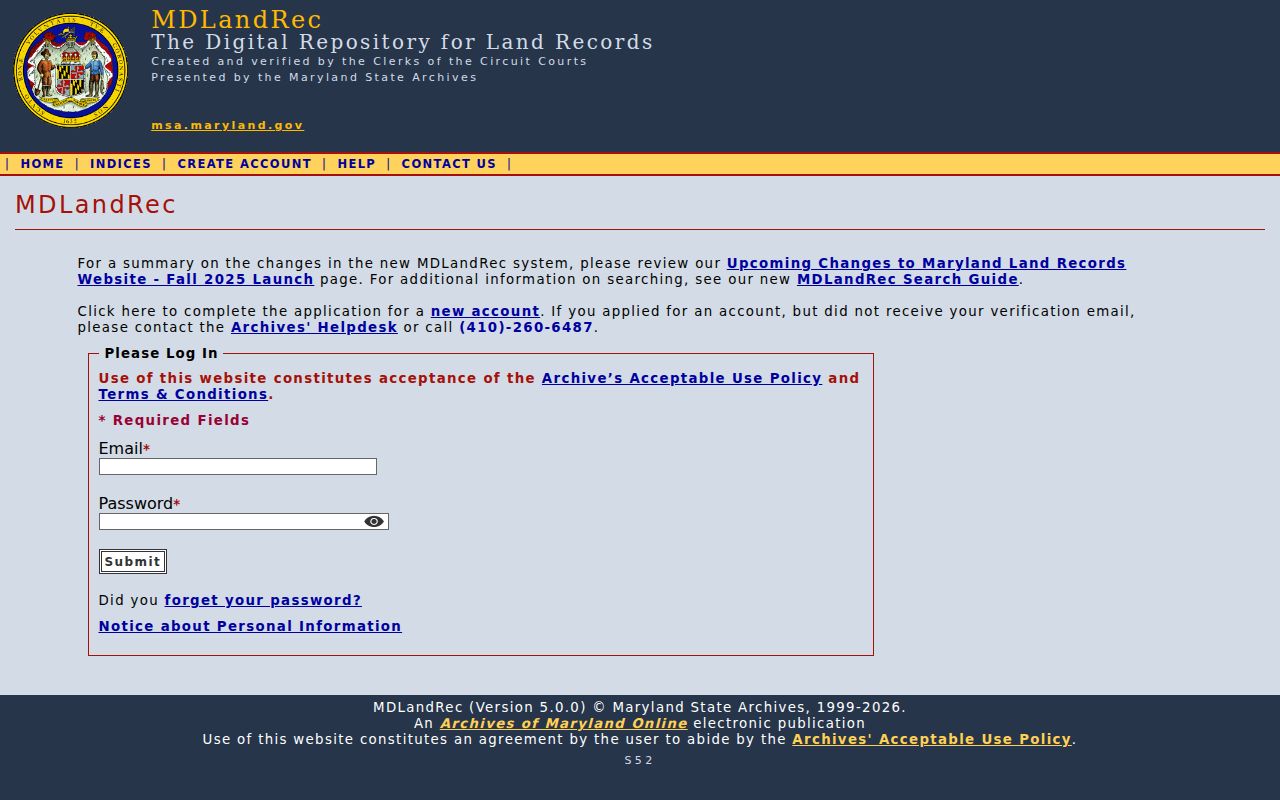
The screen is the bridge from a recorded reference to an image, but only the clerk can issue an official certified copy.
Narrow Middle River Court Searches
The Maryland Judiciary Case Search and Record Portal covers public summary information from the District Court and Circuit Court serving Baltimore County. Person search requires a last name. First and middle names, Baltimore County, court, case type, and filing dates can reduce false matches. An ending percent sign supports partial first or last names under the portal rules. Broad results stop at 500, so common names demand tighter filters.
| Court source | People-search value | Full-record fallback |
|---|---|---|
| District Court for Baltimore County | Traffic, criminal, and civil party summaries | Clerk where the case was filed |
| Circuit Court for Baltimore County | Major civil, criminal, family, and appeal dockets | Clerk file or public terminal |
| Register of Wills | Decedent, estate, status, and representative clues | Estate file from the Register |
| U.S. District Court | Federal party and case indexes | PACER, clerk terminal, or NARA |
A docket is the chronological list of filings and court events. Online summaries can include party names, city and state, case number, charges, dates, disposition, and event history. They are not certified records. Adoption, juvenile, sealed, expunged, and shielded material may be absent or restricted, and some family financial documents stay closed.
Middle River Court Portal Changed
Maryland launched its integrated Case Search and Record Portal on March 14, 2026 after postponing an earlier rollout over data-conversion issues. The public summary remains a discovery tool, while authorized users may have broader document functions. Entries can update soon after clerk action, but the agreement warns that the database is informational rather than authoritative.
When a name match matters, keep the case number and request the public file from the court where it was filed. Older material may need advance retrieval. A missing online charge can reflect shielding rules, case outcome, spelling, court coverage, or digitization rather than proof that no record exists.
Find Middle River Estate Trails
Maryland Estate Search accepts a decedent’s first and last name, county, estate type, status, date, or a complete estate number. Results may identify the decedent, estate number, date opened, type, status, and clues about a personal representative. A personal representative is the person authorized to administer the estate.
For a lawful heir search, the online entry is the start. Ask the Baltimore County Register of Wills for the will, petition, inventory, account, or other public filing. Older estates may have moved to the Maryland State Archives. Compare the decedent’s address and relatives with deeds, obituaries, cemetery records, and vital sources rather than relying on one shared name.
Middle River Vital Records Paths
The Maryland Division of Vital Records handles qualifying birth, death, marriage, and divorce products. Baltimore County Health also provides certain local birth and death certificates. Recent birth records are restricted to the registrant, qualifying relatives or representatives, and authorized requesters. Death certificates have a restricted requester group for the first ten years under Maryland Health-General §4-217.
Marriage can mean a license application, certificate, index entry, or state verification. Divorce verification is not the court decree. The Circuit Court holds the decree and public parts of its file. Applications commonly require event details, relationship or authority, identification, signature, and the current payment. The office, mail, and authorized online channels each use their current form rules.
The state birth-record page explains eligibility and application choices for a Middle River vital-record request.
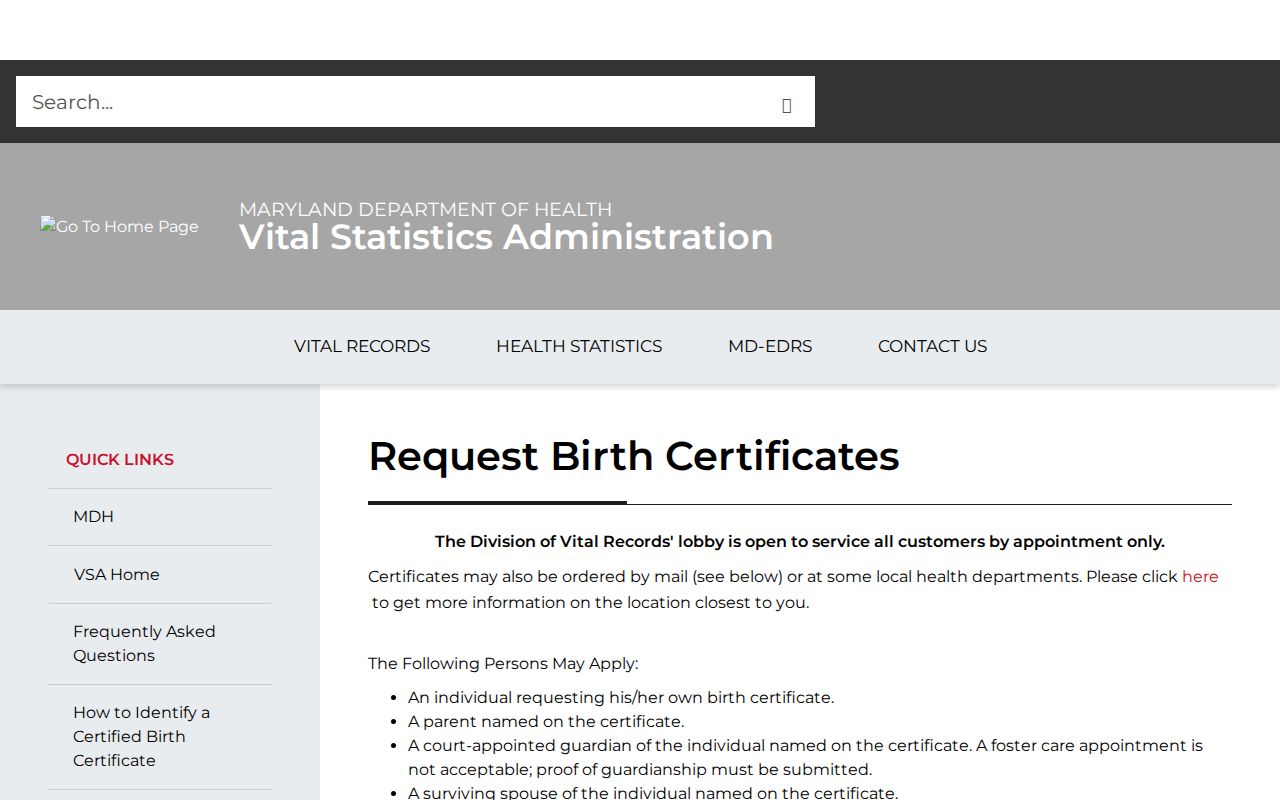
This official route is for eligible certificate requests; genealogy research usually begins with archival series and their access notes.
Search Middle River History Offline
The Maryland State Archives Guide identifies Baltimore County land, court, probate, tax, and vital series by creating agency and inclusive dates. Search by county and record type, record the series number, and note whether access is online, by request, or in person. Census schedules through 1950 can identify households, though early schedules may organize the area by election district rather than the modern Middle River label.
Baltimore County Public Library provides genealogy databases and newspaper access subject to its licenses. The Historical Society of Baltimore County adds more than 4,300 volumes, 10,500 photographs, 4,400 surname files, cemetery inscriptions, maps, limited yearbooks, and city or county directories. Its collection is noncirculating, so ask staff to confirm a specific directory volume before visiting. Church registers, cemeteries, and newspapers can fill gaps before statewide civil registration.
- Index
- A finding list that points to a record, not the complete record.
- Certified copy
- A custodian-issued copy authenticated for official use.
- Enumeration district
- The small geographic unit used to organize a census count.
- Plat
- A recorded map showing lots, roads, and survey geometry.
Martin Photos Name Middle River Families
The Library of Congress holds 101 photographs from August 1943 documenting Glenn L. Martin worker trailer communities, homes, gardens, clinics, and visiting nurses. Some captions name residents and relatives. Those names are leads, not complete family profiles. Compare them with the 1940 and 1950 censuses, Baltimore newspapers, directories that cover the road, marriage and death records, probate files, and cemetery inscriptions.
Plant No. 2 also links narrative history to exact property records. The Maryland Historical Trust entry identifies the Eastern Boulevard site, inventory BA-2824, construction history, and deed and parcel references. Moving from that historic description to SDAT, then MDLandRec, plats, and county GIS can verify ownership and land change. It cannot identify every worker or nearby resident.
Check Middle River Public Rosters
Maryland licensing systems can distinguish two people with the same name. Maryland OneStop leads to board-specific tools for occupations such as medicine, nursing, real estate, contracting, and cosmetology. A result may show license number, type, status, issue and expiration dates, public contact details, and discipline links. No single database covers every board, so verify through the agency that issued the credential.
Business Express searches an entity name or Department ID and can return status, type, principal office, resident agent, and filing history. A resident agent accepts legal papers and is not necessarily the owner. State unclaimed-property search is another free name trail, but making a claim requires identity and relationship proof.
| Official source | What it establishes | What it does not establish |
|---|---|---|
| License roster | Credential and public status | Every current residence |
| Business filing | Entity role and filing details | That the agent owns the company |
| Commercial people-finder category | Compiled leads of uncertain age | An official or certified record |
Middle River Custody Search Fallbacks
Baltimore County does not publish a conventional, continuously browsable jail roster. County custody questions go through the Department of Corrections or Maryland VINE. State-sentenced custody can be searched through the DPSCS Incarcerated Individual Locator by name or identifier. These systems describe custody status, not a general directory of Middle River residents.
Use the Maryland Sex Offender Registry only within its statutory warning and for lawful safety purposes. Do not use an entry to threaten, harass, or harm anyone. If an online tool does not resolve the question, contact the responsible agency and provide a full name, date of birth when lawfully available, and any known identifier.
Request Missing Middle River Records
The Maryland Public Information Act, General Provisions Title 4, is the fallback when a Baltimore County or state record is public but has no suitable portal. Send a focused request to the office that keeps the record. Describe the record series, names, dates, address, and preferred format. Ask for inspection or electronic delivery when that fits the need.
A custodian should produce a record at once when possible. Otherwise, the usual response framework calls for an initial response within ten working days and a grant or denial within no more than thirty days, subject to the statute. Reasonable search, preparation, and copy fees may apply, although the first two hours of search and preparation are generally not charged. Exempt information can be withheld while segregable public portions should be released.
A public record is not always remotely searchable. The Act does not require an agency to create a new database, answer research questions, or disclose protected fields. Preserve the request, estimate, dates, and any denial for agency review, Ombudsman mediation, an eligible Compliance Board dispute, or judicial relief.