
Check Middle River Voter Records
Begin at the official Maryland Voter Lookup. The service is for a voter checking their own record, not for browsing names across Middle River. Enter the data as it appeared on the registration. The state updates the lookup each day, but changes made that same day will not appear. An online or Motor Vehicle Administration submission may take as long as three weeks to process.
The lookup can confirm voter registration, identify the polling place and local board, show election districts, display a sample ballot, and report mail-in or provisional ballot status. A voter may also request a duplicate registration card. These functions make it a personal election-service tool rather than a public name index.
| Lookup field | Entry type | Required | How to enter it |
|---|---|---|---|
| First name | Text | Yes | Use the registered form; letters and spaces only. |
| Last name | Text | Yes | Letters, hyphens, and spaces are accepted. |
| Date of birth | Numeric date | Yes | Enter month, day, and a four-digit year. |
| ZIP code | Text | Yes | Use the five-digit residential ZIP on record. |
| Street number | Text | No | Numbers, letters, commas, hyphens, and slashes are accepted. |
| Middle initial | Text | No | Use the initial on the registration. |
If no match appears, retry the exact registered name, including Jeff versus Jeffrey. Use the former ZIP or street after a recent move, or the former surname after a name change. Wait through the stated processing period when the application is new. The Baltimore County election office is the next channel when those checks fail.
The official lookup screen shows the fields that separate a personal check from an open directory.
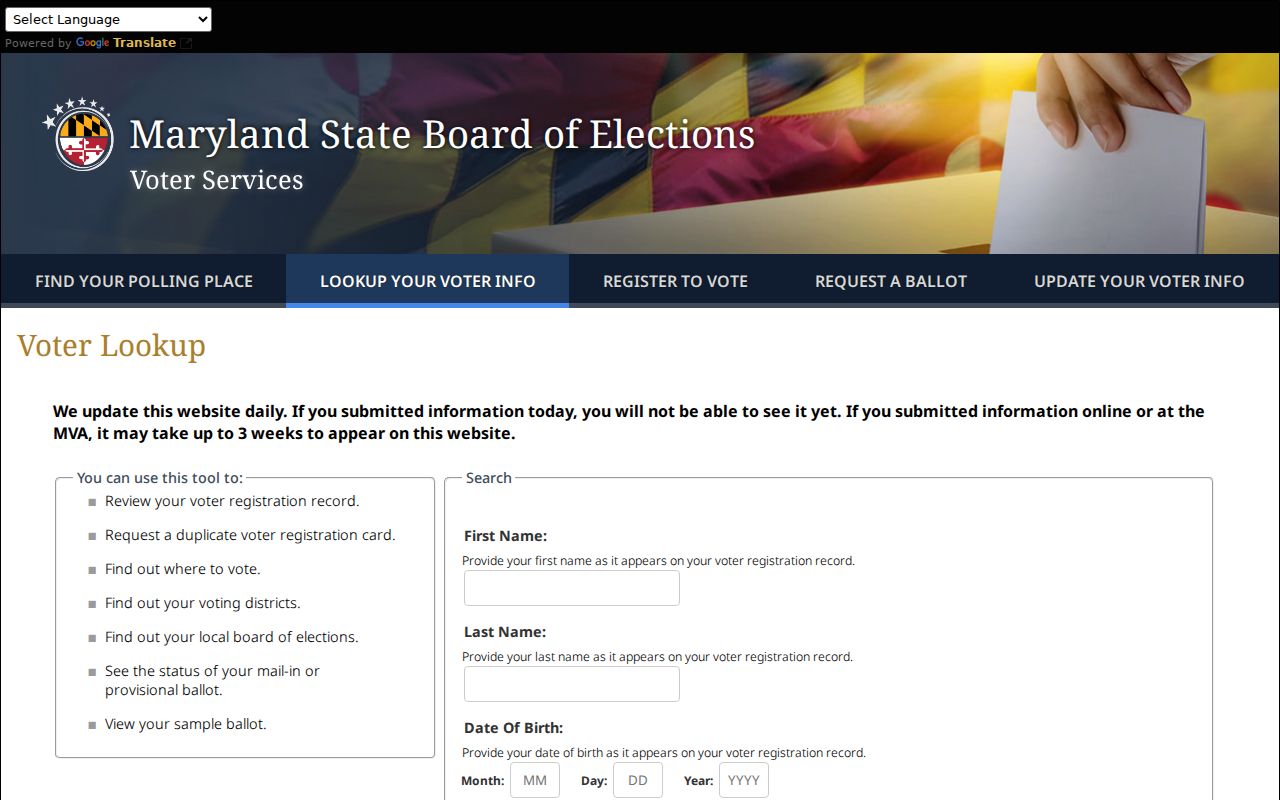
That identity gate is central: a name alone cannot expose a Middle River voter record through the public interface.
Middle River Lookup Is Personal
A common myth treats voter registration as a free neighborhood directory. Maryland draws a sharper line. The online tool requires several facts about one voter, and the downloadable voter file is available only through a signed, purpose-limited request. Neither route is a casual way to list everyone who lives on a Middle River street.
This distinction also explains why a failed personal search should go to an election official rather than a general records request. Maryland Election Law controls the voter file. The broader Middle River public records process does not cancel election-law limits or reveal a protected field.
Use voter data lawfully. Voter information does not authorize unwanted contact, surveillance, threats, impersonation, stalking, or harassment.
Fields in Middle River Voter Files
Maryland's downloadable documentation describes far more than the personal lookup screen. A registered-voter file may carry identity, registration, geography, and district fields. A district field places a voter within an election boundary; it does not prove the person owns a home or still receives mail at every address shown.
| Identity | Voter ID, name, party, and gender. |
|---|---|
| Addresses | Residential and mailing addresses, except protected data. |
| Registration | Active or inactive status plus state and county registration dates. |
| Precinct | Split and precinct assignment. |
| Districts | Congressional, legislative, councilmanic, ward, municipal, and commissioner fields when applicable. |
| Jurisdiction | County and related election geography. |
Confidential by law. Maryland Election Law §§3-505 and 3-506 governs access, while an approved confidentiality request protects a qualified voter's residential address, email, and phone from ordinary disclosure.
Mail-in, early-voting, provisional, and cure lists carry fields tied to those processes. Their status data should be read in context, because each file answers a different election-administration question.
Middle River Voting History Limits
Voting history records participation, never a person's ballot choices. The history can identify a voter ID, election date and description, election type and code, party, voting method and date, precinct, early-voting location, jurisdiction, and county. A mark means the voter took part through the recorded method. The secret ballot remains secret.
A party field reflects registration. A history row reflects participation. Neither reveals a vote for a candidate, question, or issue. Maryland offers an included five-election history with some registered-voter requests, and a requester may select separate history on the state form.
Note: Treat an active or inactive label as an election status, not a broad judgment about where a person lives now.
Protecting Middle River Voter Addresses
The State Board confidentiality form offers a specific protection route. Qualified threatened people, certain crime victims or witnesses, law-enforcement personnel, judges, and their immediate family members may apply with supporting proof. The protection covers the residential address, email, and telephone number in the voter record.
Protection changes how the voter uses election services. A protected voter cannot use the ordinary online confirmation and ballot-status tool and does not receive certain standard mailings. Limited disclosure may still occur to jury officials, when law requires it, or through a court process. Maryland's Safe at Home program is another official address-confidentiality channel for eligible residents.
Middle River Election Office Channels
Middle River is an unincorporated Baltimore County community. It has no city election clerk and no separate municipal voter roll. Registration corrections and local questions go to the Baltimore County Board of Elections. The county office is the fallback for a lookup that will not match, a delayed registration update, or a question about polling and election districts.
Baltimore County Board of Elections
5 Crossing Way
Owings Mills, MD 21117
410-887-5700
elections@baltimorecountymd.gov
Maryland State Board of Elections
151 West Street, Suite 200
Annapolis, MD 21401
410-269-2840
dlPSR_sbe@maryland.gov
The state directory of local boards confirms the county channel. Official monthly registration statistics are published by county and party, not as a Middle River census-designated-place table. Do not turn a Baltimore County total into a local count.
The county election office page is shown in the captured official source.
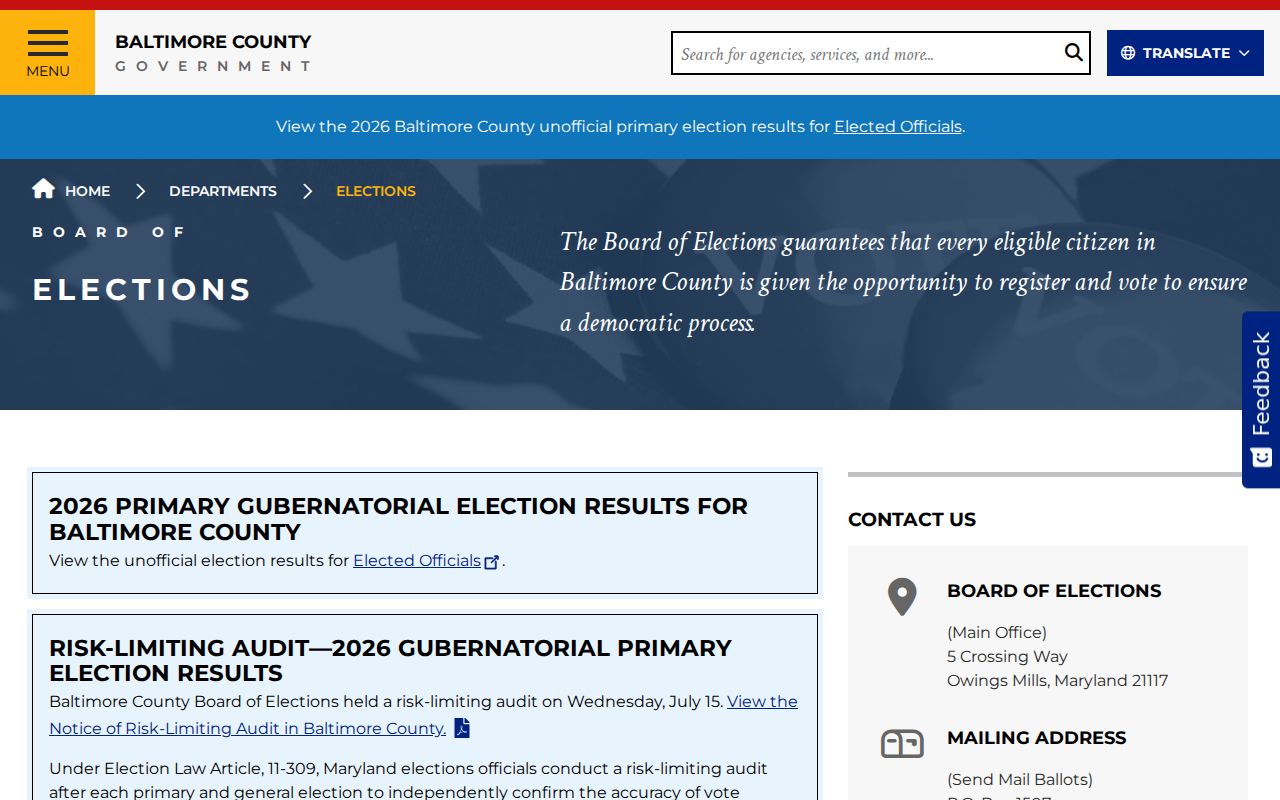
The county page bridges the statewide service and a Middle River resident whose record needs staff help.
Requesting Middle River Voter Rolls
A voter list request goes to the Maryland State Board of Elections. Under Maryland Election Law §§3-505 and 3-506, the applicant must be a registered Maryland voter. The applicant signs under penalty of perjury that the file will be used for an electoral-process purpose, not commercial solicitation or another purpose. Middle River is not a municipal list option, so request Baltimore County, an eligible district, or a statewide file.
- Open the current Registered Voter List Request Form and provide the applicant, registration, contact, and organization details that apply.
- Describe the electoral-process use, select the region and list type, then choose party, status, date, district, and election options as needed.
- Sign the certification, select FTP or flash-drive delivery, and submit payment to Maryland SBE through one of the listed methods.
The county or single-district fee is $75. A statewide file costs $125. FTP delivery by email is free, while a flash drive adds $15 and may be picked up or mailed. Registered-voter data arrives as tab-separated text; a walking list is an uneditable PDF. The state does not supply custom formats or technical support, and a large file can exceed a spreadsheet program's row limit.
Payment may be made by credit card, certified check, personal check, campaign check, or money order payable to Maryland SBE. A returned check carries a $30 fee. Processing is within ten working days. During the election blackout, submit by the registration deadline 21 days before the election or wait until after election day.
Maryland Voter File Choices
The request form offers more than one voter registration product. Choosing the narrow file that fits the authorized use reduces cost and keeps the data easier to handle. A registered-voter list can be limited to active voters, a registration-date range, named parties, or all parties including inactive registrations.
| File choice | Form and content | Key distinction |
|---|---|---|
| Walking list | Street-sorted precinct PDF with voters grouped under addresses and party | Even street numbers appear left and odd numbers right. |
| Registered voter | Tab-separated bulk fields with optional five-election history | Built for data filtering, not page-by-page street use. |
| Mail-in | Permanent applicant or election-specific fields, request status, and ballot address | Tied to mail-in administration. |
| Early, provisional, or cure | Site, date, ballot style, precinct, issue, reason, or change fields | Each tracks a distinct election process. |
A walking list is arranged for a precinct and street. Bulk voter rolls are tab-separated records meant for database work. The same request form lists gubernatorial and presidential primary and general election choices from 2006 through 2026.
Middle River Voter Data Limits
The electoral-purpose oath is a binding restriction. The request form bars commercial solicitation and other non-electoral uses. It also prohibits distributing, selling, or transferring the voter file. A requester should keep the signed purpose, selected scope, delivery record, and all later use aligned.
Knowing misuse under Election Law §3-506 is a misdemeanor. The penalty is 30 days to six months in jail, a fine of up to $250, or both. Separate Maryland laws prohibit stalking, harassment, and misuse of electronic communication. Access to voter records never grants permission to pressure, track, threaten, or harm a person.
Note: Ask the State Board before requesting data if the proposed purpose does not fit the electoral-process certification.
Middle River's Historical Voter Trail
Current voter registration is not the only election trail. Maryland State Archives series BRG11-5 preserves Baltimore County poll books from 1803 through 1888. A separate 1786 House of Delegates poll book can be viewed as images. These sources can place a named person within an election district and period when a modern online lookup has no role.
The key is old geography. Middle River's modern census and postal name is not the archive's organizing label. Identify the period election district or precinct first, then search the surviving poll book. Exact entry fields in the long county series require archival inspection, so do not assume a modern voter-file layout.
Historical poll books also demand careful identity checks. Match the name with land, probate, census, or directory evidence from the same era. Similar names, old boundary terms, and spelling variants can otherwise join the wrong voter to a Middle River family line.